Potter Museum of Art’s landmark Indigenous art show
An exhibition that sought to redefine Australian art and reveal hidden histories closed at Melbourne University’s Potter Museum of Art in late 2025 having attracted 50,000 visitors. According to its organisers, it made a significant contribution to cultural understanding.
Opening in May as the first show at the refurbished Potter Museum of Art in Swanston St, 65,000 years: A Short History of Australian Art was hailed by one high-profile reviewer as “something that will blow people’s minds”.
The show collated and explained an extraordinary array of pieces from around the continent, and from across mediums, genres and time periods.
Its aim, according to University of Melbourne director of art museums Charlotte Day, was to celebrate and share the “rich, dynamic culture-making” of Indigenous Australians while also telling stories about colonisation and its ongoing impacts through their perspectives.
The exhibition’s 11 galleries – each dedicated to place, people, theme or phase of colonisation – were decorated in different colours and arranged across several levels, with the visitor travelling further north in Australia as they moved upwards.
On the ground floor, the forest green Art of Victoria and Lutruwita (Tasmania) gallery assembled customary cultural objects like hunting weapons together with artworks illustrating early colonial life made both by and about Aboriginal people.
These included a series of portraits of “named ancestors”, among them the Wurundjeri leader William Barak, who was said to have been present as a boy when John Batman met with elders to "purchase" the Melbourne area in 1835.
“Once my people were as many as the leaves of the gum trees, but now only old man left. Soon the white man can have it all,” Barak was quoted as saying.
Upstairs, the skill and beauty embodied in bark paintings and weavings by generations of Yolngu people across Arnhem Land was on display.
Many of the items had been commissioned or acquired in the 1930s and ‘40s by Melbourne University anthropologist Donald Thomson, whose vast collection was returned from long-term loan to Museums Victoria for the show.
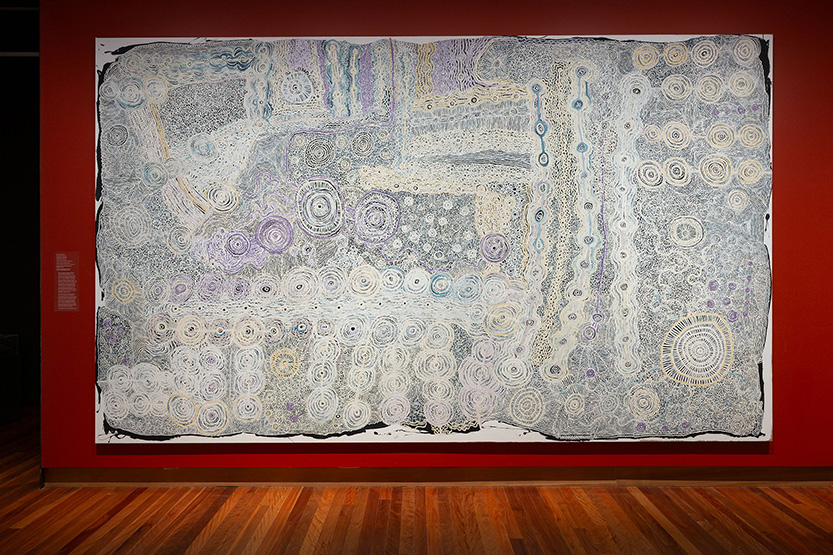
Commissioned work Ngangkari Ngura (Healing Country) by Betty Muffler and Maringka Burton.
Photo: Christian Capurro
A shift to interpreting pieces like these as art, rather than anthropological items, had taken place in recent decades, Day said, and underlining this was a key focus for the curators.
Against the red walls of the Central and Western Desert room, hung the kind of vivid, joyful depictions of country in dots, strokes and patterns that are recognised around the world as Aboriginal art, including two works by renowned Anmatyerr painter Emily Kam Kngwarray.
A gallery of a different kind – dedicated to the university’s involvement in eugenics – revealed an array of disturbing exhibits, among them a telegram ordering “70 cases for crania” to be sent to northern Victoria, where staff from the medical school were digging up bones from a burial site.
Work in other rooms offered counterpoints to the horror of this “scientific racism”.
For instance, at the top of the stairs in the Cultural Astronomy gallery – its walls black as the night sky – were the magical life-sized figures of seven sisters woven from native grasses by the Tjanpi Desert Weavers. According to the Ngaanyatjarra story, the sisters launched themselves into the sky to escape a dirty old man, creating the Pleiades constellation in the process.
According to Charlotte Day, 65,000 years had its beginnings in an invitation for Professor Marcia Langton AO to look over the university’s Indigenous collections and create a show from them.
When Langton found the holdings too geographically scattered and hatched a plan to increase the scope of the project, curators Judith Ryan AM and Shanysa McConville were brought on board.
The university, involved as part of an ongoing “truth-telling process”, worked with the trio to borrow, buy and commission pieces that would flesh out their vision of Australian art.
From inception to opening, the exhibition took a decade to develop, Day said, with a lot of time spent consulting with communities and artists.
Despite minimal funds for advertising its reputation spread, and over a five-month run it drew 50,000 people through the doors. Among them were 2500 school students and “quite a lot” of interstate and international visitors who had come specifically to Melbourne to see the show, Day said.
In addition to the exhibition itself, a book documenting and extending its content was produced and has already been reprinted. The project has also seen the creation of resources for schools, which are online and free, through the university’s Ngarrngga program, according to Day.
Overall, the museum’s director thinks the exhibition has made a significant contribution in a context of incremental change.
“I think we did have an impact in terms of increasing people's understanding of the history of Australia … and maybe in having a more nuanced understanding of Australian culture,” she said.
“This is hopefully part of a broader movement in Australia to really celebrate what's special and unique to our culture.”
And what that is, she believes, begins and might end with First People’s artmaking and meaning.
Information about the exhibition is available on the Potter Museum of Art website.
The book, 65,000 Years: A Short History of Australian Art, is available from Readings or the North Carlton library.
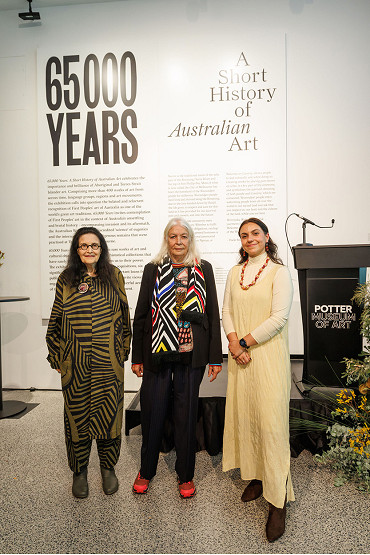
Caption: 65,000 Years: A Short History of Australian Art curators Judith Ryan AM, Professor Marcia Langton AO and Shanysa McConville. Photo: James Henry.
Related Articles
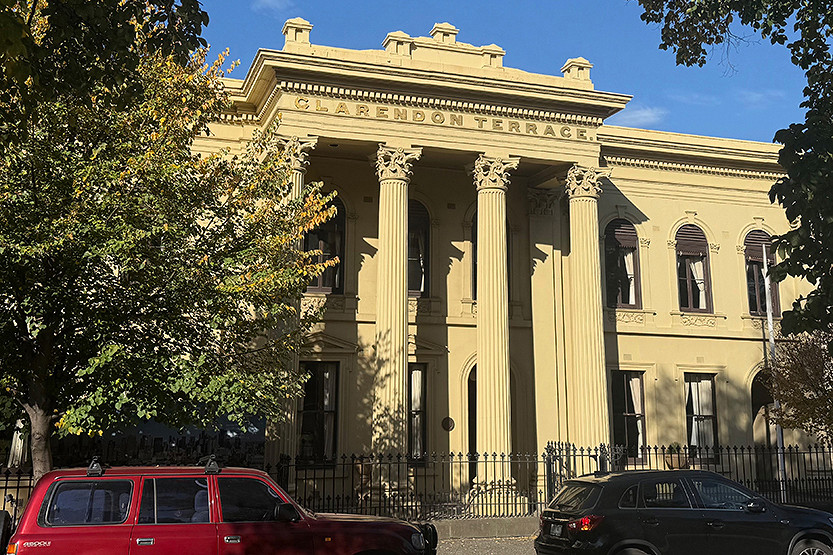
The unsolved mystery attached to one of Melbourne’s most historic homes
Walking down Clarendon St in East Melbourne, the National Trust-owned Clarendon Terrace stands out for its Corinthian four-column portico and gold inscription.
Read More
La Mama to launch three-month season of bold new works
La Mama Theatre will launch one of its most anticipated annual programs on June 2, with EXPLORATIONS returning for a three-month season of brand-new works-in-progress.
Read More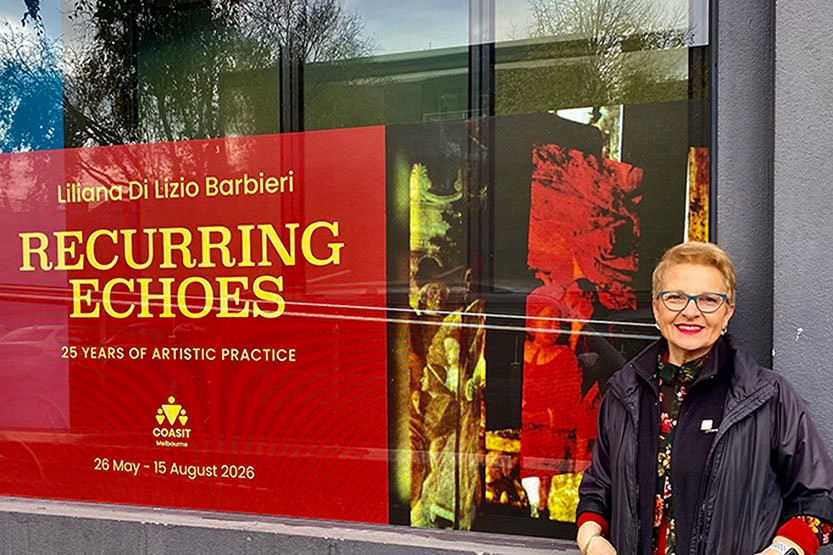
Artist’s career comes full circle in Carlton exhibition
A new exhibition in Carlton is celebrating more than two decades of work by Italian-Australian artist Liliana Di Lizio Barbieri, bringing together paintings, photography, installations and sculptural works created across her career.
Read More
Da Guido La Pasta enters its next chapter
Infrastructure plan puts focus on Carlton, Parkville and East Melbourne
 Download the Latest Edition